
Workforce Management in the Age of AI: Forecasting a Blended Human-Bot Team
Workforce management has always been the discipline of putting the right number of agents, with the right skills, in the right place at the right time. For decades, the core math stayed relatively stable: forecast contact volume, estimate handle times, apply service level targets and calculate staffing.
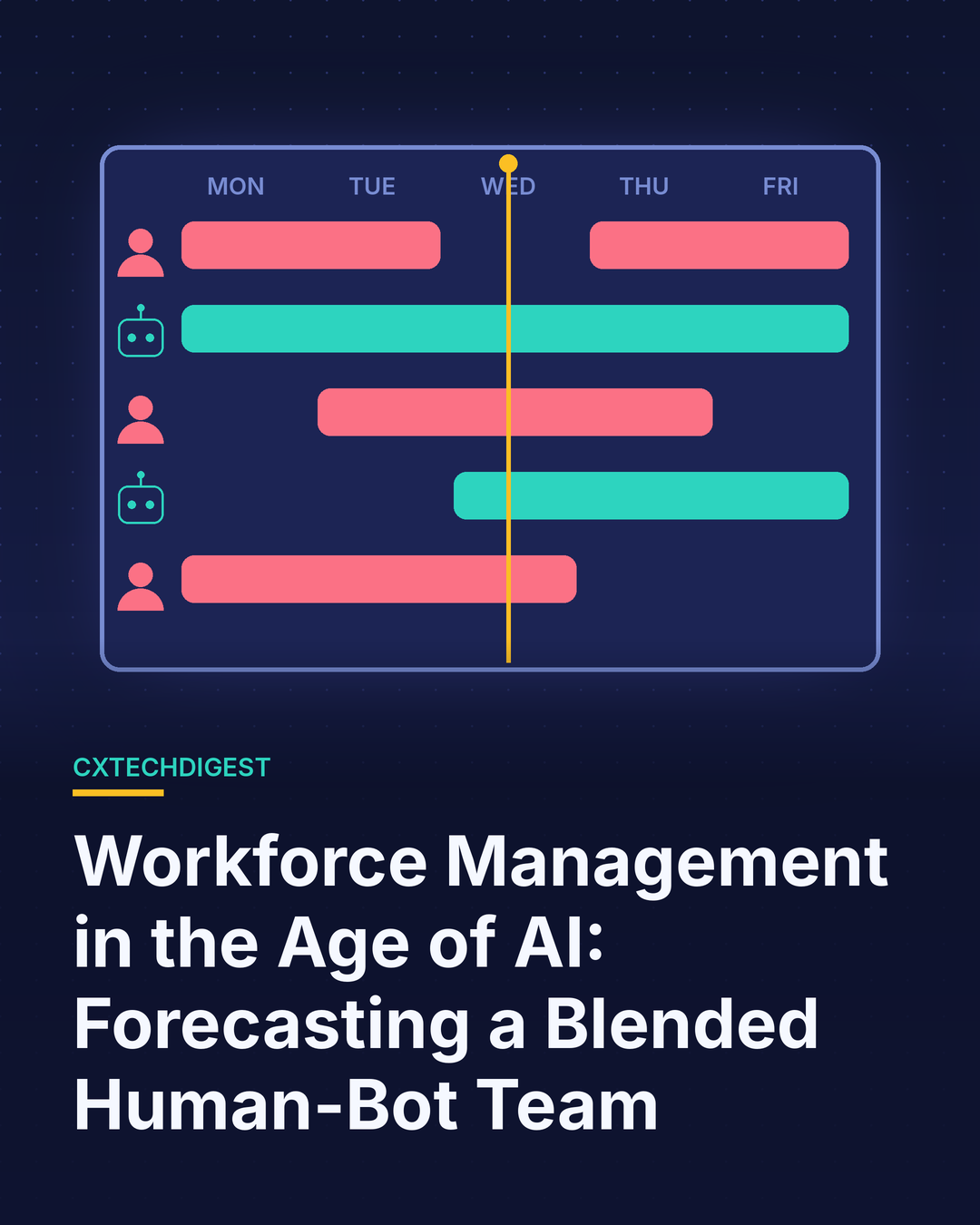
AI agents break that model. When a growing share of contacts is resolved by AI, and the remaining human interactions are longer and more complex, traditional forecasting assumptions no longer hold. WFM teams now need to plan for a blended workforce of people and AI.
What changes in the forecast
Volume splits into two streams. Forecasts must now predict not only total demand, but how much AI will resolve and how much will reach humans. That split varies by intent, channel, time of day and customer segment.
Containment isn’t constant. AI resolution rates change as knowledge bases improve, new intents are automated and customers adapt. A forecast that assumes a fixed automation rate will drift quickly.
Escalations create new patterns. Contacts that start with AI and escalate to humans arrive with different timing and often longer handle times. Spikes in AI failures, such as a system outage or an unexpected product issue, can send sudden surges to human queues.
Human work gets harder. As AI absorbs simple contacts, the average human interaction becomes longer and more complex. Historical handle time data will understate future staffing needs if this shift isn’t modeled.
New work appears. Reviewing AI conversations, training models, updating knowledge and handling exceptions all require human time that traditional WFM models don’t capture.
Building the blended plan
Forecast by intent. Break demand into customer intents and assign each an expected AI resolution rate, escalation rate and human handle time. This gives a far more accurate picture than channel-level forecasting.
Treat AI as capacity with limits. AI agents scale easily, but their capacity is bounded by what they can resolve, integration reliability and service costs. Model them as part of the workforce, with performance metrics and failure scenarios.
Plan for scenarios. Model what happens if AI containment rises faster than expected, or if an outage pushes all contacts to humans. Maintain contingency plans and flexible staffing options for those moments.
Update skills planning. Human agents increasingly need advanced problem-solving, technical knowledge and emotional resilience. Schedule training time and plan for specialized skill groups.
Recalculate shrinkage and occupancy. With harder contacts, agents need more recovery time between difficult interactions. Pushing occupancy to traditional levels with more complex work accelerates burnout.
Use AI to manage AI-era workforces
Modern WFM platforms are using AI to improve forecasting accuracy, adjust intraday staffing in real time, automate schedule changes and give agents more flexibility through self-service shift swaps. These capabilities become essential as demand patterns grow more volatile.
Rethink the metrics
Traditional measures like service level and average handle time remain useful, but they need context. Track AI resolution and escalation rates by intent, total cost per resolution across AI and human channels, customer satisfaction for blended journeys, and agent wellbeing indicators alongside efficiency.
The bottom line
AI doesn’t eliminate the need for workforce management. It makes it more strategic and more complex. WFM teams that forecast by intent, model AI as part of the workforce and plan for the changing nature of human work will help their organizations capture the benefits of automation without sacrificing service or burning out their people.