
Grounding AI in Your Own Data: Why Retrieval Beats Retraining for Most Businesses
When executives first consider applying generative AI to their own business, a common assumption follows: the model must be trained on the company’s data. It seems intuitive. If we want the AI to understand our products, policies and customers, surely we must teach it.
For the great majority of enterprise use cases, however, that assumption is incorrect, or at least premature. A more practical and economical approach is retrieval-augmented generation, usually abbreviated as RAG.
How retrieval works
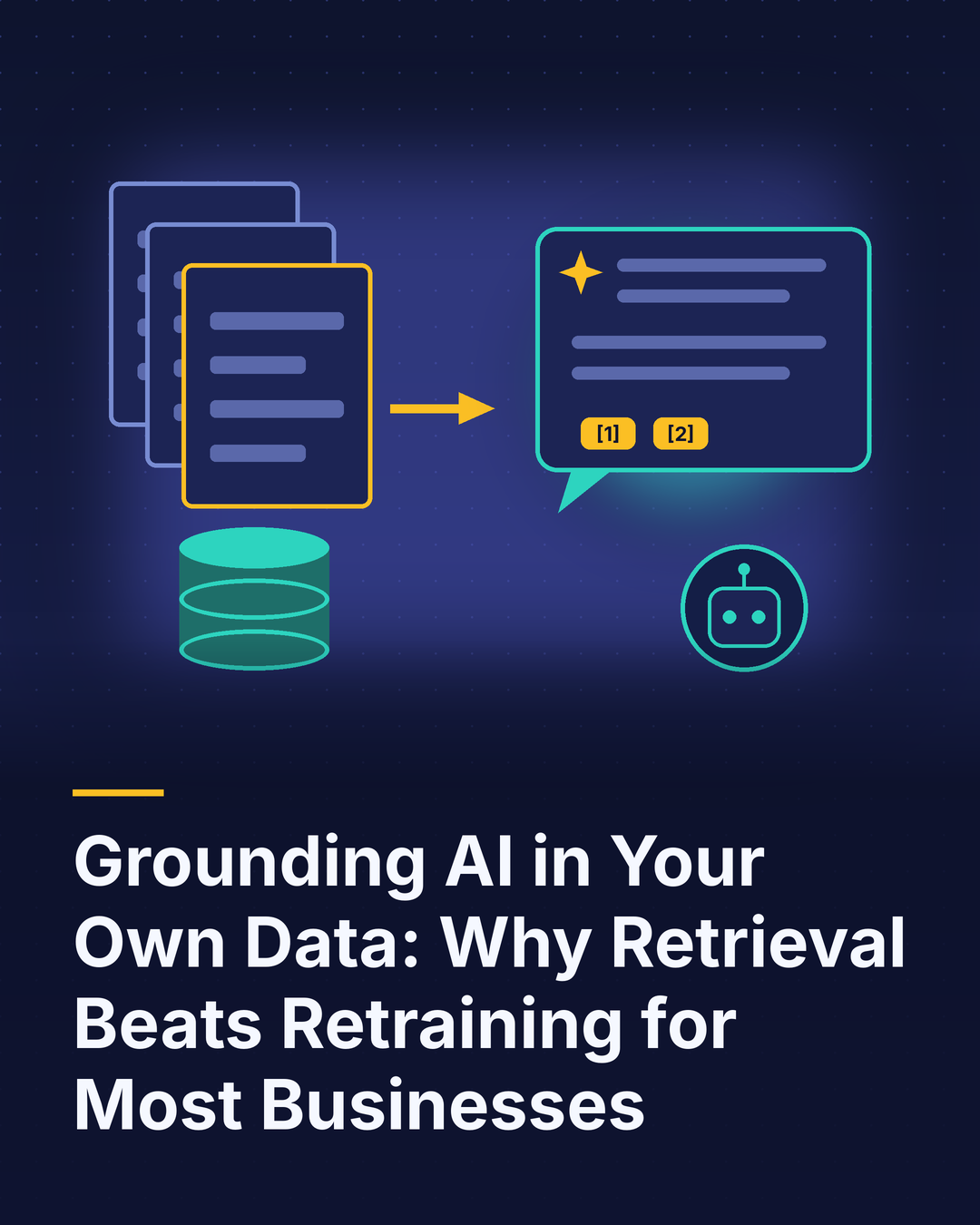
Rather than altering the model itself, retrieval supplies the model with relevant information at the moment a question is asked. When a user submits a query, the system searches the organization’s approved knowledge sources, such as policy documents, product manuals, contracts or support records, and passes the most relevant passages to the model along with the question. The model then composes an answer grounded in that material, ideally with citations to the source.
The model’s general language capability remains intact. What changes is the evidence it draws upon.
Why retrieval is usually the better choice
Currency. Enterprise information changes constantly. With retrieval, updating a document updates the answers. A retrained model, by contrast, reflects only the data available at the time of training.
Traceability. Answers can cite their sources, which allows users to verify them and gives auditors a clear record.
Access control. Retrieval can respect existing permissions, so employees receive answers based only on the documents they are entitled to see. Embedding sensitive information into a model’s weights makes such control considerably more difficult.
Cost and speed. Retrieval systems can be built and adjusted in weeks. Training or fine-tuning requires specialized expertise, substantial compute and repeated effort as data changes.
When fine-tuning has a place
Fine-tuning remains useful in specific circumstances, for example when a model must adopt a particular style or format, or perform a narrow, specialized task with high consistency. In practice, many mature systems combine both techniques, using retrieval for knowledge and fine-tuning for behavior.
Getting retrieval right
The quality of a retrieval system depends heavily on the underlying data. Documents must be current, well structured and properly governed, and the search component must be tuned and evaluated with the same care as the model itself. Cloud platforms now offer managed search, vector storage and grounding services that reduce the engineering burden considerably.
The bottom line
For most organizations, the fastest and most reliable route to useful enterprise AI is not to retrain a model, but to connect a capable model to well-governed company knowledge. Retrieval keeps answers current, verifiable and secure, at a fraction of the cost. Any organization beginning this journey should invest first in the quality of its information, since that investment will serve every subsequent AI initiative.