Latest from IBM

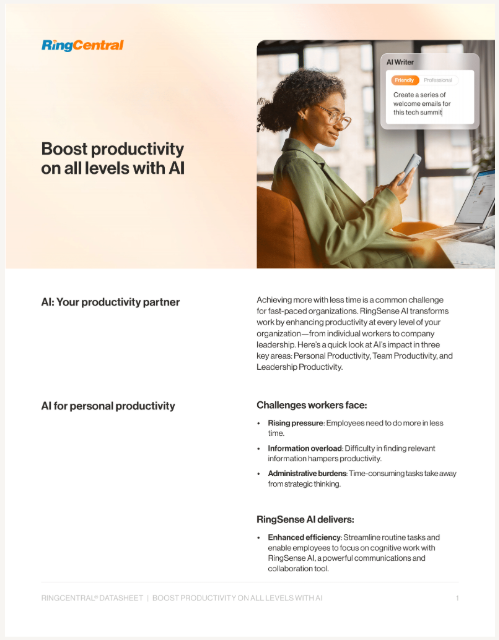
2025 trends in cloud communications: The CIO guide

Stay ahead of the curve with 2025 trends in cloud communications: the CIO guide. Explore emerging technologies like artificial intelligence (AI), unified communications as a service (UCaaS), and 5G that are transforming business communications. Learn actionable steps to future-proof your organization. What you’ll learn: • How AI and UCaaS improve team collaboration and customer engagement […]

Read →

From headcount to high impact: The C-suite guide to using workforce planning strategically

Today’s leaders face a dual mandate: grow the business while reducing costs. At the same time, AI adoption and demographic shifts are transforming the global workforce. Research from Sapient Insights Group shows how organizations with long-term workforce planning can see improvements in innovation, customer retention, and profitability. In this report, you’ll see how the most […]

Read →
article

The AI Revolution Coming to Transform Your Business Network

B2B Integration is viewed as a competitive differentiator for best-in-class companies and by 2020, 50% of all business software will incorporate AI technology. Discover three ways you can apply AI – today – to build a modern, faster, more efficient B2B network. • Access detailed, real-time transactional intelligence across your business • Gain in-depth, real-time […]

Read →
article

Global Mailbox: Enabling Always-On Operations and Greater Resilience to Disruptions

For companies operating in the highly-connected global economy, digital connections with customers, suppliers and business partners are critically important. To sustain and optimize business performance, these connections must be scalable, secure and always-on.  B2B Integrator 6.0 introduces new features for:• Enabling hybrid cloud deployment via Docker containers• Seamless integration with RESTful APIs • High-availability operations with […]

Read →
article

5 Steps to Achieve Risk-Based Application Security Management

Typically, IT and business management have no visibility into the overall state of application security. Activities for assessing, prioritizing and remediating application vulnerabilities are ad hoc, fragmented, and carried out at low levels in the IT security organization. Quality assurance and software development groups lack the knowledge and incentives to address critical vulnerabilities early in […]

Read →
25,000+
Articles
500K+
Monthly Readers
300+
Sponsors
15+
Years of Insights